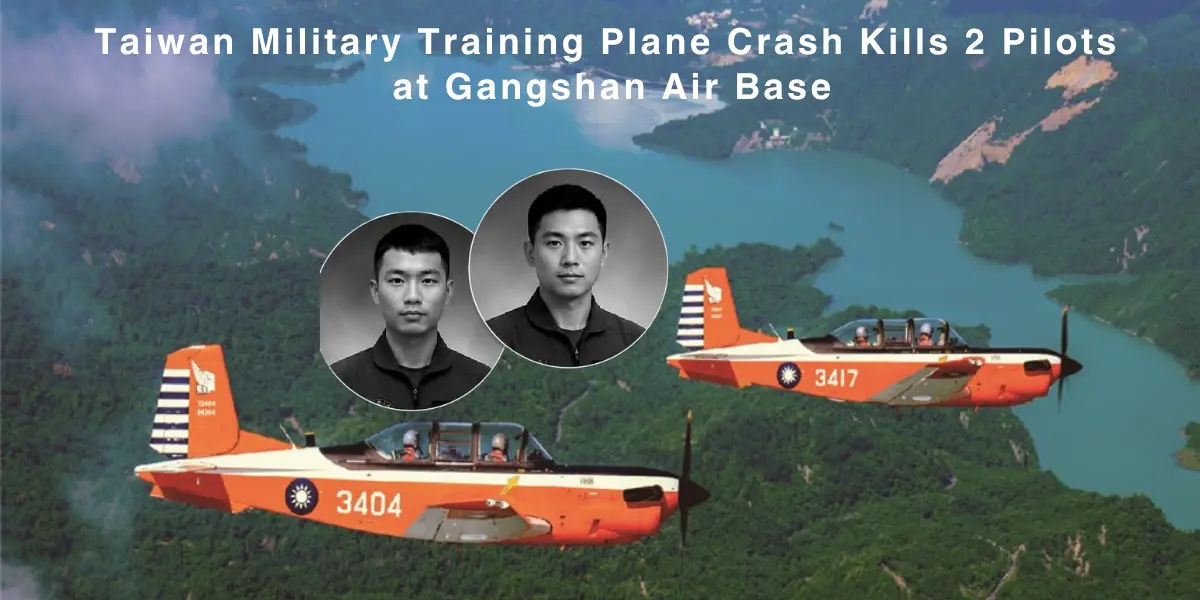
Two experienced Taiwan Air Force pilots died on Tuesday morning when their T-34C trainer aircraft crashed at Gangshan Air Base in Kaohsiung during a simulated engine failure exercise. The crash has grounded Taiwan's entire T-34 fleet and triggered a parallel military and prosecutorial investigation.
Both pilots were lieutenant colonels with over 2,000 flight hours each. The cause remains officially unknown.
What Happened: The June 2 Crash at Gangshan
The T-34C aircraft, bearing tail number 3414, took off from Runway 36L at Gangshan Air Base at 7:47 a.m. on June 2, 2026. The crew was conducting a simulated engine-failure route training mission a standard exercise designed to train pilots in emergency procedures when an engine stops working in flight.
At 8:08 a.m., the aircraft crashed near the northern end of the runway. Emergency rescue personnel reached the scene and extinguished the fire by 8:53 a.m. Both pilots were found dead inside the wreckage.
The Taiwan Air Force confirmed the crash the same morning. Air Force Chief Inspector Major General Chiang Yi-cheng held a press briefing in Kaohsiung and stated that the pilots had reported no anomalies or malfunctions before the crash occurred. The full Air Force briefing was reported by Focus Taiwan CNA, the government official English-language news service.
Who Were the Two Pilots
The two pilots have been formally identified as:
Lt. Col. Lu Chi-yu (盧季佑), age 41, seated in the front cockpit as chief instructor. He graduated from the Republic of China Air Force Academy in 2008 and had logged 2,114 flight hours in the T-34C. He was being evaluated during this flight.
Lt. Col. Kuo Chun-nan (過俊男), age 46, seated in the rear cockpit as the examiner. He graduated from the Air Force Academy in 2004 and had logged 2,172 flight hours in the T-34C. He was conducting the evaluation.
Both men were married and are survived by their families. Both were considered experienced instructor-level pilots by the Air Force not cadets or new trainees.
Taiwan's President Lai Ching-te expressed his condolences publicly, describing the pilots as "heroic" and thanking them for their "sacrifice and dedication" to Taiwan. He directed the defense ministry to establish a task force to determine the cause as quickly as possible.
Air Force Commander General Cheng Jung-feng traveled personally to the crash site. Minister of National Defense Wellington Koo ordered a thorough investigation and instructed the military to provide full support to the families of the deceased.
The Aircraft: What Is the Beechcraft T-34C?
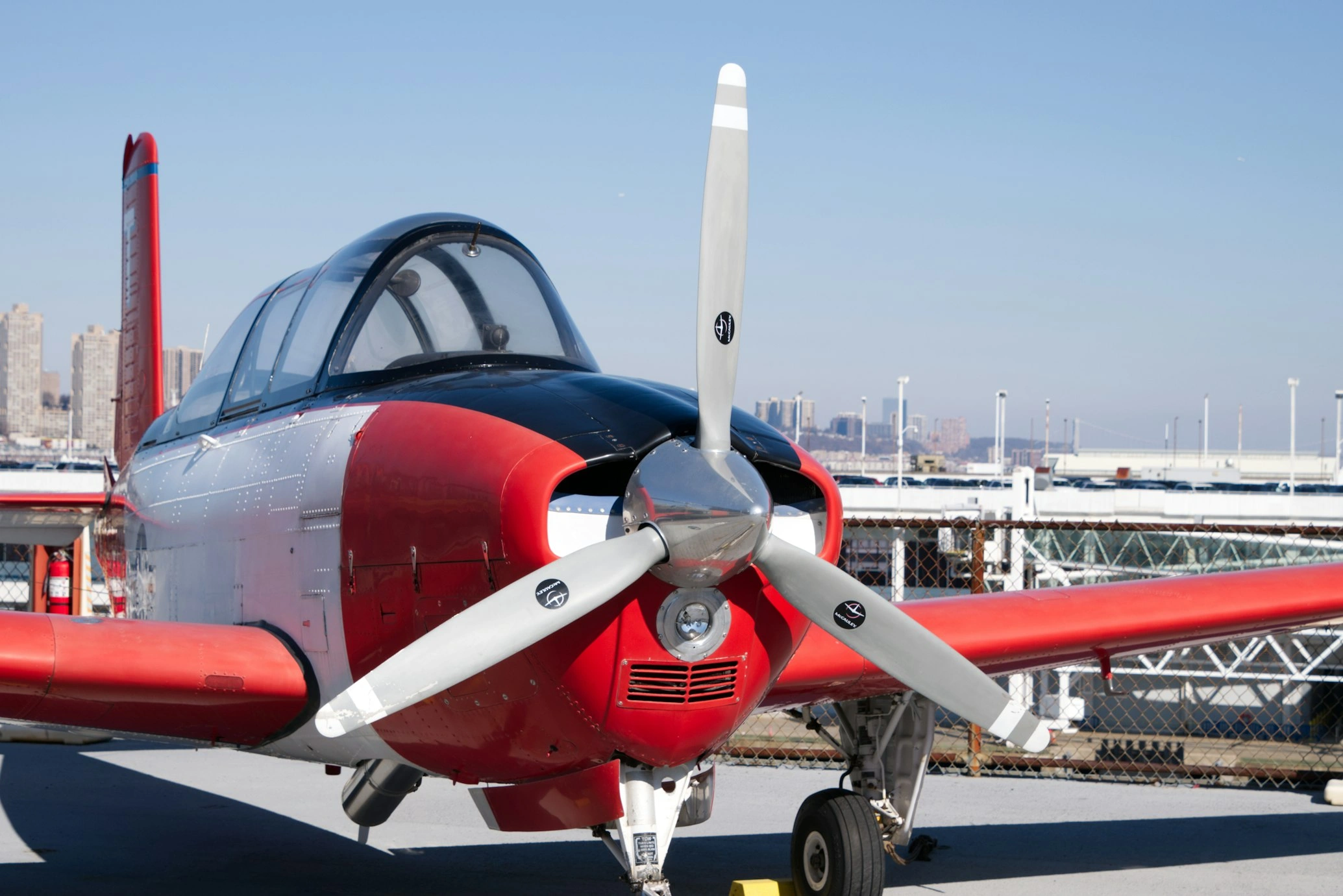
The T-34C Turbo Mentor is a single-engine turboprop training aircraft built by Beechcraft in the United States. It was designed as a primary trainer the first aircraft a military pilot flies after basic flight school before advancing to jets and operational combat aircraft.
Taiwan's Air Force received its T-34C fleet beginning in 1984 and 1985. Production of the T-34C model ended globally in 1990. That means the aircraft flying at Gangshan on June 2 was at least 35 years old.
Aircraft | Beechcraft T-34C Turbo Mentor |
Role | Primary military trainer |
Engine | Single turboprop (Pratt & Whitney Canada PT6A-25) |
Crew | 2 (tandem seating instructor rear, student front) |
First delivered to Taiwan | 1984–1985 |
Production ended | 1990 |
Estimated fleet age | 35–42 years |
Active T-34C units in Taiwan | Approximately 34 aircraft |
Operator | Republic of China Air Force Academy, Gangshan |
Taiwan's Air Force uses the T-34C as the entry-level trainer before cadets progress to the AT-3 jet trainer and eventually to the F-16. The career path of a military pilot from basic trainer to operational aircraft is one of the most demanding in aviation, a reality reflected in how pilot training and compensation is structured at major carriers even on the commercial side. The aircraft has been a standard part of Taiwan's pilot pipeline for four decades.
Investigation: What Is Known and What Is Not
The Air Force has formed a special task force to investigate the crash. Prosecutors in Kaohsiung launched a parallel civil investigation the same day, working alongside military police and air force flight safety investigators. The crash site has been sealed off while forensic evidence is collected.
The key facts confirmed so far:
The pilots reported no anomalies or malfunctions before departure
The crash occurred approximately 21 minutes after takeoff
The exercise was a simulated engine failure meaning the crew was intentionally practicing procedures for an engine-out scenario
The Air Force has grounded all T-34C trainers pending thorough safety checks
No mechanical issues were flagged during the pre-flight or the flight itself, according to the Air Force briefing
What remains unknown is why the aircraft went down. The investigation will examine:
The aircraft's mechanical condition and maintenance history
Whether the simulated engine failure procedure contributed to the accident
Flight data and cockpit voice recordings if available
Structural integrity of the airframe given the aircraft's age
Whether maintenance contractor Aerospace Industrial Development Corporation (AIDC) followed all required procedures
The Air Force has not disclosed whether the crew attempted any recovery procedure before impact.
The Fleet Age Debate: A Question That Was Already Being Asked
The crash has reignited a debate that Taiwan's defense establishment was already having before June 2.
The T-34C fleet was delivered to Taiwan in the mid-1980s. Production of the model ended in 1990. That puts Taiwan's current trainers between 35 and 42 years old. In January 2024, Taiwan's Air Force stated that the T-34C fleet was not expected to reach the end of its service life until 2033 to 2035 giving it roughly another decade of planned operational use.
One day after the crash, the Air Force issued a statement saying the fleet "has not yet reached retirement age" but that it is "proactively" seeking replacements. It confirmed that maintenance contractor AIDC conducts regular checks in accordance with its contract, and that replacement parts remain available and in sufficient supply.
However, the political and public pressure has clearly shifted. The crash of a 40-year-old aircraft during a training exercise that involves intentional engine simulation has made the age question unavoidable.
Taiwan's AIDC has already completed the first design stage of a domestic replacement trainer. A prototype could be ready by 2028 and mass production could begin by 2031, according to AIDC's earlier public statements. The Air Force has also considered leasing trainers from abroad as an alternative to procurement. No final decision has been made on a replacement path.
Taiwan's Recent History of Military Aviation Accidents
The June 2 crash is not an isolated event. Taiwan's Air Force has experienced a series of training-related accidents in recent years that have maintained public and political focus on aviation safety within the military.
Date | Aircraft | Location | Outcome |
January 2026 | F-16 fighter jet | Off eastern Taiwan | 1 pilot missing, presumed dead |
June 2026 | T-34C trainer | Gangshan Air Base, Kaohsiung | 2 pilots killed |
May 2022 | AT-3 jet trainer | Gangshan area | 1 cadet killed (solo training) |
2010 | T-34C trainer | Southern Taiwan | 2 pilots killed |
Aviation safety infrastructure at airports serving both military and civilian operations remains a recurring concern across Asia. The Pokhara International Airport investigation offers a parallel case study in how airport-level safety questions shape national aviation credibility.
The January 2026 F-16 crash is particularly significant context. A fighter jet went down off eastern Taiwan during a routine training mission. The pilot is believed to have ejected but has not been found. That incident, combined with the June 2 T-34 crash, means Taiwan has now lost three military pilots in training accidents in the first half of 2026 alone.
What Happens Next
Taiwan's Air Force has grounded the entire T-34C fleet. Training flights on those aircraft will not resume until the safety checks are complete and investigators have at minimum ruled out any fleet-wide mechanical risk.
The special task force investigation has no confirmed timeline. Military accident investigations of this nature typically take several months to produce formal findings. Prosecutors in Kaohsiung are conducting a separate legal inquiry, which runs on a different track from the Air Force's internal safety investigation.
The debate over the T-34 fleet's future is now directly tied to this investigation's findings. Aircraft age and airframe fatigue are not unique concerns to military aviation understanding how the Boeing 787 and A350 differ in design philosophy and longevity shows how airframe lifespan decisions shape every tier of aviation. If the crash is attributed to age-related airframe or component issues, the pressure to accelerate fleet replacement will intensify significantly. If the cause turns out to be procedural or relates to the simulated engine failure exercise itself, the aircraft's airworthiness may not be the central issue but the safety of the training protocol will be.
For official updates on Taiwan's military aviation safety investigations, the Republic of China Ministry of National Defense publishes statements as inquiries progress.
Minister of National Defense Wellington Koo has ordered full support for the families of Lt. Col. Lu and Lt. Col. Kuo. President Lai's statement has set a clear public expectation: the cause must be identified, and steps must be taken to prevent a repeat.
Aviation safety incidents at civilian and military airports close to populated areas carry similar risks to surrounding communities. The Turkish Airlines landing gear fire at Kathmandu covered in our Turkish Airlines fire in Kathmandu report illustrates how rapidly a runway incident can escalate even at well-equipped airports.
Air Gazette will update this report as the investigation develops.
Frequently Asked Questions
What caused the Taiwan military training plane crash on June 2, 2026?
The cause is under investigation. The Air Force confirmed that the pilots reported no anomalies before the crash and that the exercise involved a simulated engine failure. A special task force and civilian prosecutors are jointly investigating. No official cause has been determined.
Who were the pilots killed in the Taiwan T-34 crash?
Lt. Col. Lu Chi-yu, 41, with 2,114 flight hours in the T-34C, and Lt. Col. Kuo Chun-nan, 46, with 2,172 flight hours in the aircraft. Both were experienced instructor-level pilots not student cadets. Lt. Col. Lu was being evaluated and Lt. Col. Kuo was serving as the examiner.
What is a simulated engine failure exercise?
It is a standard military training procedure in which pilots practice the actions required when an engine fails in flight including power reduction, glide path management, and emergency landing procedures. The exercise involves intentionally simulating the loss of engine power to train pilots in how to recover the aircraft safely.
Why has Taiwan grounded all T-34C trainers?
Following the crash, the Air Force grounded the entire T-34C fleet pending thorough safety checks. This is a standard precautionary response after an unexplained accident involving a specific aircraft type. The grounding will remain in place until inspections are complete and investigators can rule out any systemic airworthiness issue.
How old is Taiwan's T-34C fleet?
Taiwan received its T-34C trainers beginning in 1984 and 1985. Production of the T-34C ended in 1990. That places Taiwan's active aircraft at between 35 and 42 years old. The Air Force has stated the fleet has not reached its designed service life end, which it estimated at 2033 to 2035.
Has Taiwan considered replacing the T-34C?
Yes. Taiwan's domestic aerospace company AIDC has completed the first design stage of a replacement trainer aircraft. A prototype could be ready by 2028 and mass production by 2031. The Air Force has also considered leasing trainers from abroad. No final decision on a replacement path had been made before the crash.
How many military aviation accidents has Taiwan had in 2026?
As of June 2026, Taiwan has experienced two confirmed fatal military training accidents. An F-16 fighter jet crashed off eastern Taiwan in January 2026, with the pilot missing and presumed dead. The T-34C crash at Gangshan on June 2, 2026, killed both pilots on board. Three military pilots have been lost in the first half of 2026.