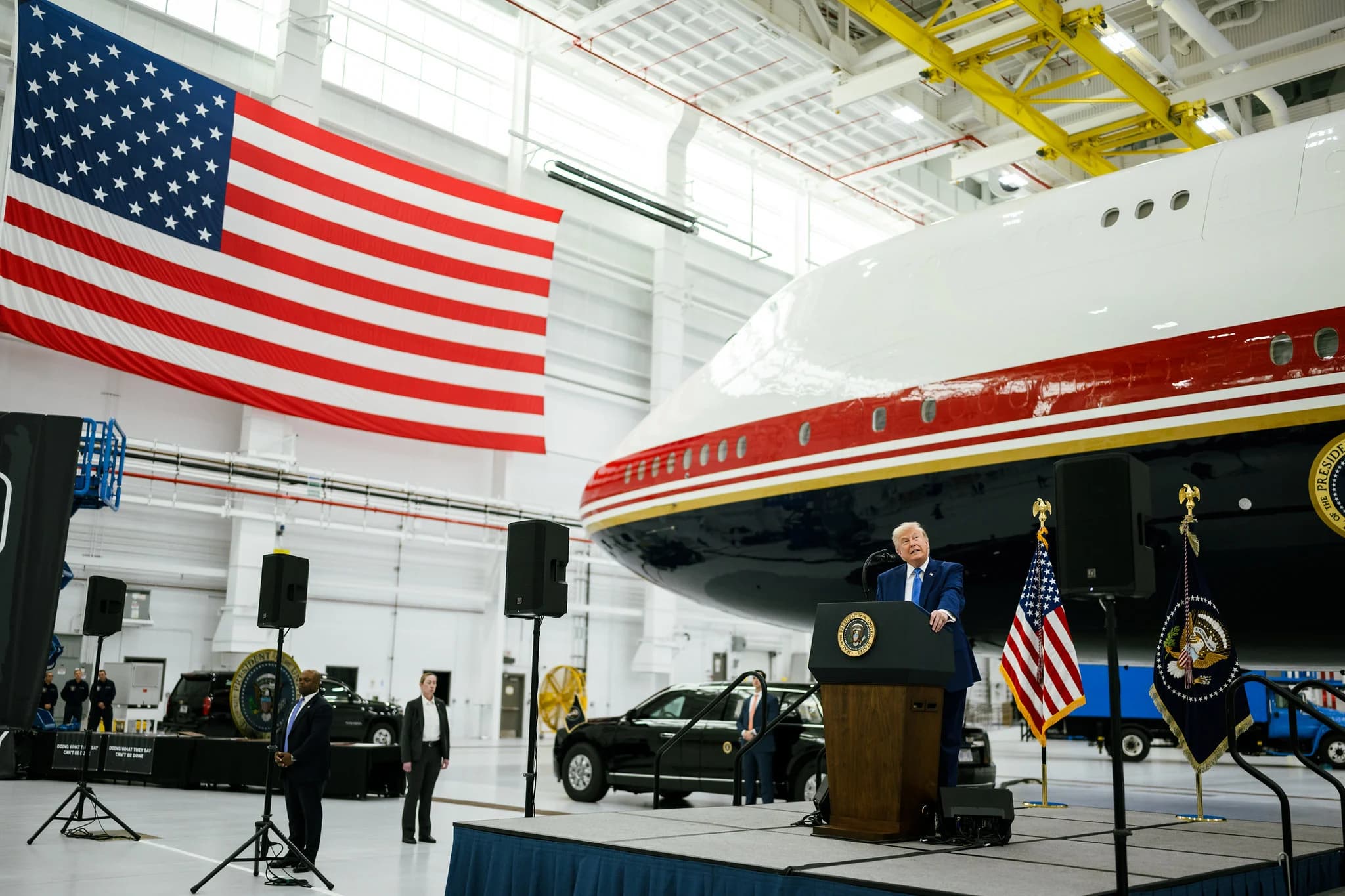
On June 19, 2026, Donald Trump walked down the stairs of a Boeing 747-8 at Joint Base Andrews to the sound of "God Bless the USA." Every major outlet ran the story as if a new era of presidential aviation had already begun. Headlines described it as the arrival of a new Air Force One. The photos were dramatic. The reality was different.
It hadn't started yet. Trump walked through the cabin, descended the stairs for cameras, gave a speech and that was it. He has never flown on the Qatar jet. What happened on June 19 was a ceremony. What happens next is a story most outlets haven't fully told and the details matter more than the photos.
What the June 19 Ceremony Actually Was
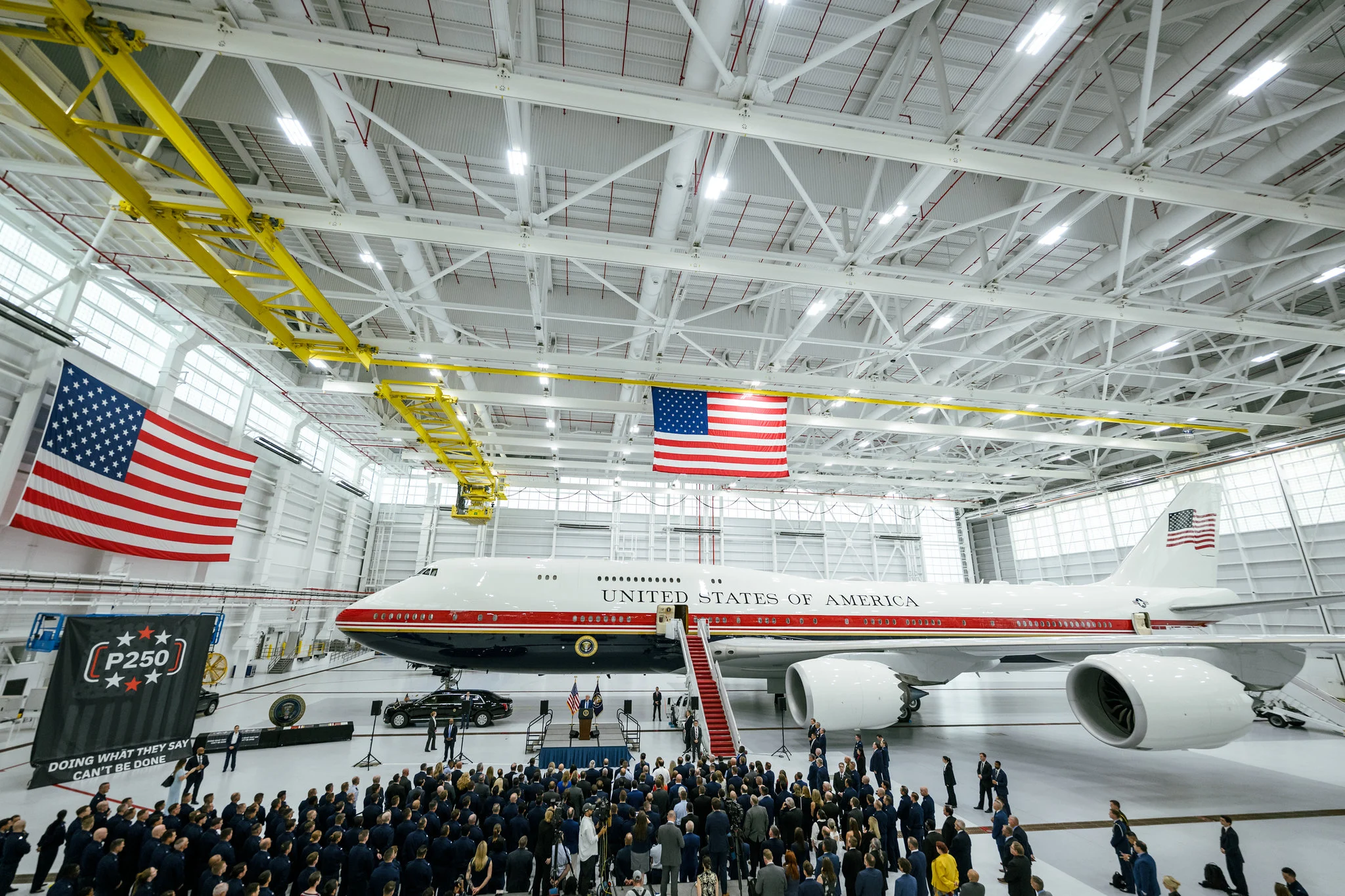
Let's be clear about what happened that day. The event at Joint Base Andrews was an unveiling a reveal, not a departure. Trump toured the interior, called it the "world's most luxurious plane," and addressed a crowd of Air Force personnel inside the hangar.
After the ceremony, the aircraft officially designated the VC-25B Bridge immediately entered what the Air Force calls commissioning flights. Think of it as a final exam. Specifically, White House staff need to validate mission capabilities in flight, Air Force personnel need to finalize operational protocols, and security systems need verification under real conditions before any president steps aboard for an actual mission.
Here's the detail most outlets buried. The week before the ceremony, Trump flew to the G7 summit in Europe on the old VC-25A the same aging Boeing 747-200B that has carried every U.S. president since George H.W. Bush in 1990. Meanwhile, the Qatar jet sat on the ground the entire time. In other words, the ceremony was not the beginning of a new chapter. It was a photo opportunity ahead of one.
Why Does This Plane Even Exist?
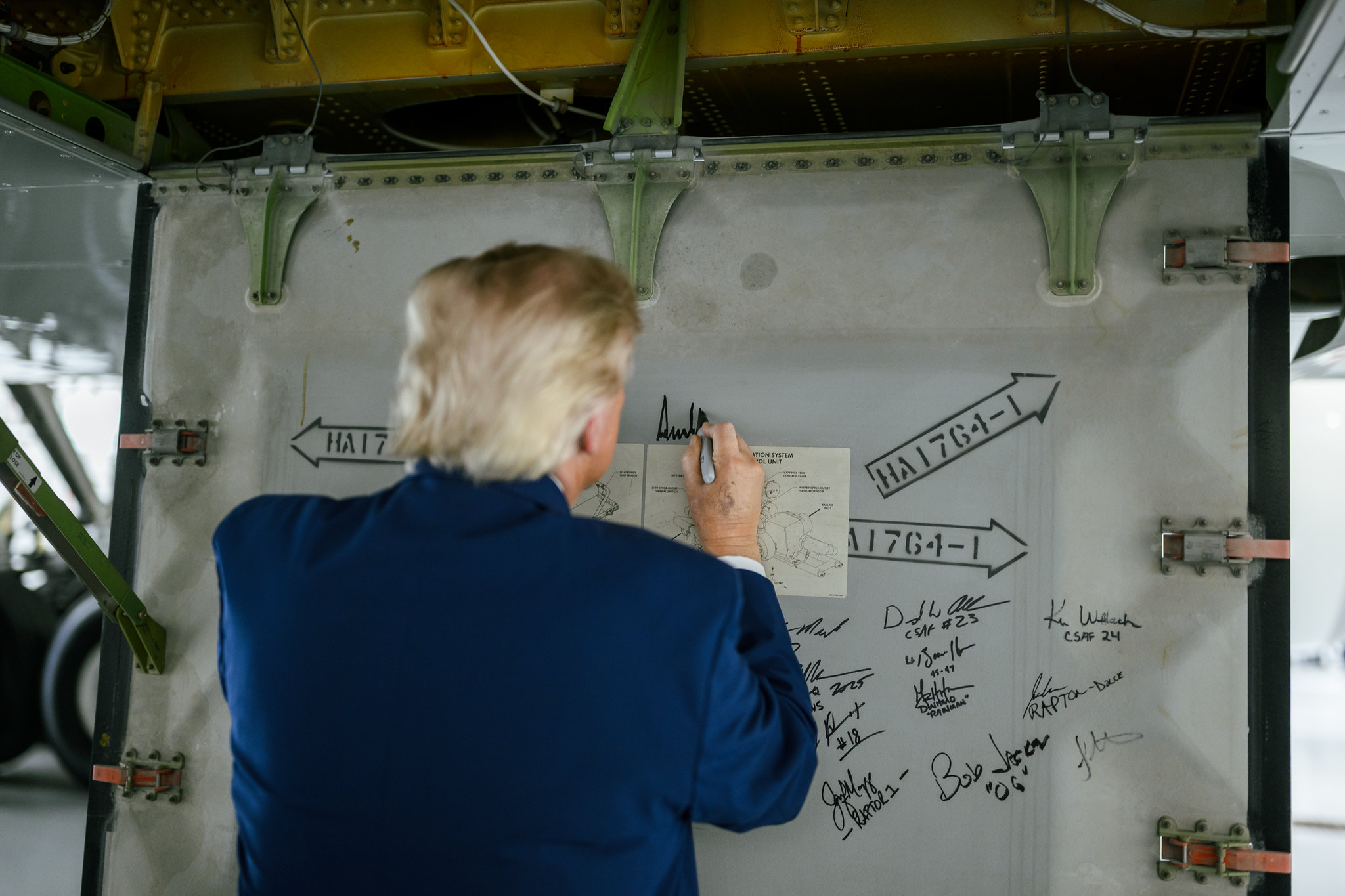
To understand the Qatar jet, you first need to understand how badly Boeing dropped the ball. The U.S. Air Force signed a $3.9 billion contract with Boeing in 2018 for two brand new purpose-built presidential aircraft. They were supposed to arrive in 2024. However, they are now not expected until 2028 four years late with supply chain disruptions, labor shortages, and technical redesign problems all cited as causes.
Meanwhile, the existing VC-25A fleet was aging fast. Both aircraft are now over 35 years old. Maintenance windows were growing longer with every passing year. As a result, the Air Force had no approved contingency when Boeing's delays became impossible to ignore.
That is where Qatar stepped in. The royal family owned a Boeing 747-8 built in 2012 for the House of Thani a newer, larger, more capable aircraft sitting largely unused. After U.S. special envoy Steven Witkoff arranged for the plane to fly to Palm Beach in February 2025, Trump inspected it personally. Subsequently, the Pentagon formally accepted the gift in May 2025, Defense Secretary Pete Hegseth signed the memorandum on July 7, 2025, and defense contractor L3Harris Technologies began military conversion work in San Antonio. The Air Force named it the Bridge aircraft deliberately it bridges the gap until Boeing eventually delivers the real thing.
What Did the $400 Million Conversion Actually Cover?
This is where the official story and the reported reality start to diverge. Air Force Secretary Troy Meink told Congress in June 2025 that security modification costs came in under $400 million. However, that figure does not include the value of the aircraft itself, which is estimated at around $400 million based on market valuation of a 2012 Boeing 747-8.
Cost Component | Official Figure | Notes |
Aircraft gift value | ~$400 million | Market valuation of a 2012 Boeing 747-8 |
Modification cost (L3Harris) | Under $400 million | Per Air Force Secretary Meink, June 2025 |
Funds diverted from Sentinel program | ~$934 million | Reported by The New York Times, July 2025 |
Permanent VC-25B program (Boeing) | $1.17 billion over 5 years | Ongoing, separate from Bridge aircraft |
The New York Times reported in July 2025 that $934 million was quietly transferred from the Sentinel nuclear missile modernization program to fund the retrofit. In other words, money was pulled from a program designed to modernize America's land-based nuclear deterrent and redirected to fit out a luxury aircraft. Furthermore, the classified nature of that spending has made independent verification impossible, and bipartisan criticism from Congress was significant. According to the Associated Press, both legacy VC-25A aircraft will remain operational alongside the Bridge jet, with the Presidential Airlift Group selecting aircraft per mission.
What L3Harris actually did goes well beyond new paint. First, the conversion team stripped the plane to bare cables for forensic security audits, verifying that no monitoring devices had been installed by previous owners. They then added anti-missile defense systems, severe weather hardening, encrypted satellite communications, and secure command-and-control systems. Notably, one capability was not added: the VC-25B Bridge cannot perform aerial refueling. That means it cannot stay airborne indefinitely during a national emergency a core Air Force One requirement that the legacy VC-25A meets and the Qatar jet does not.
New Plane, New Look How It Compares to the Old Air Force One
The first thing anyone notices is the paint. The legacy VC-25A wears the iconic robin's egg blue livery designed by Raymond Loewy during the Kennedy administration a color scheme that has defined Air Force One since 1962 and is recognized in every country on earth.
Trump, however, rejected it entirely. The VC-25B Bridge debuts a deep navy blue underbelly, a red accent stripe, and a white upper fuselage. These are colors Trump pushed for during his first term, which Biden reversed in 2023, and which Trump reinstated the moment he returned to office. Additionally, standing at over 63 feet tall with a maximum takeoff weight of 987,000 pounds, the Qatar jet is physically larger than the aircraft it is replacing.
Specification | VC-25A (Current) | VC-25B Bridge (Qatar Jet) |
Base aircraft | Boeing 747-200B | Boeing 747-8i |
Year introduced (presidential) | 1990 | 2026 |
Year built | 1987 | 2012 |
Interior space | ~4,000 sq ft | ~4,000 sq ft |
Maximum range | ~7,800 miles | ~9,000 miles |
Max takeoff weight | ~833,000 lbs | ~987,000 lbs |
Aerial refueling | Yes | No |
Livery | Kennedy-era blue/white | Trump red/white/navy |
Beyond the specs, the interior tells its own story. The Boeing 747-8i is the longest commercial airliner Boeing has ever built a genuine upgrade over the 747-200B in range, avionics, and fuel efficiency. Moreover, the interior was left largely unchanged from its Qatari royal configuration, retaining high-end wood paneling, premium leather lounges, and private bedroom suites. Trump called it a "flying White House at a level of luxury nobody has ever seen before." For more on how modern wide-body aircraft compare, see Air Gazette's breakdown of the Boeing 787 vs Airbus A350.
The Old Air Force One Is Not Going Anywhere Yet
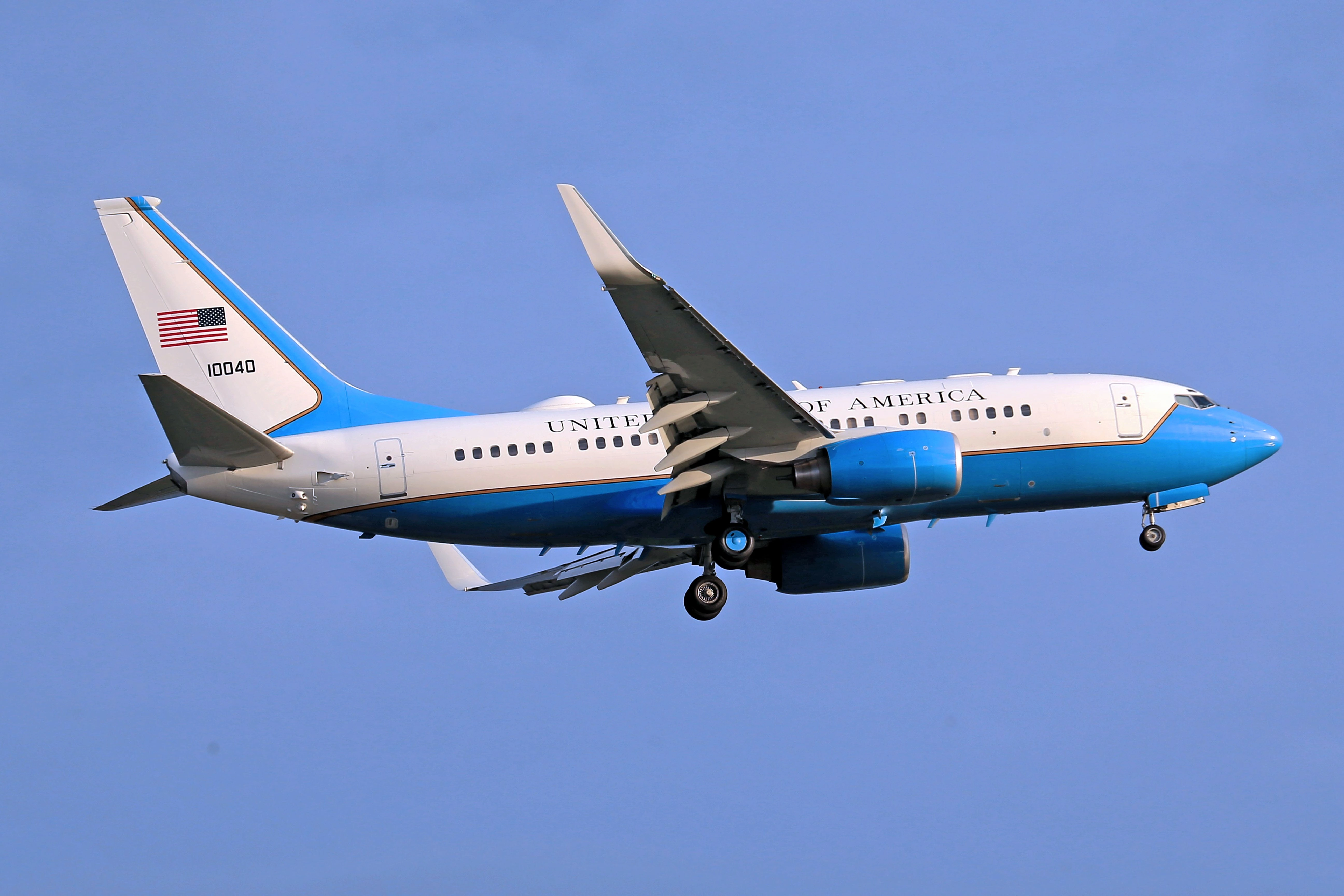
You may have read that the old Air Force One is being retired. That framing is misleading and it is worth correcting clearly.
In fact, an Air Force spokesperson confirmed to the Associated Press that both VC-25A aircraft will remain in service alongside the VC-25B Bridge. One is currently in heavy maintenance. The other continues flying. Both will be available once maintenance is complete. Therefore, the Bridge aircraft does not replace the legacy fleet it simply joins it.
Trump said the old planes would "get fixed up a little bit" and eventually go to museums, with that transition planned for 2029 when the permanent new Boeing VC-25Bs enter service. Until then, three distinct aircraft types operate in the presidential fleet: the two aging VC-25As still flying active missions, the Qatar jet completing commissioning, and two new purpose-built Boeing planes still under construction. As the airline jobs landscape in the U.S. shows, fleet transitions are almost never as immediate as headlines suggest.
So When Will Trump Actually Fly on It?
Here is what we know so far. Trump confirmed at the June 19 ceremony that he plans to fly the new plane to the NATO summit in Turkey next month and on a trip to China later in the year. Additionally, a senior White House official told NBC News that Trump is considering making his July 3 trip to Mount Rushmore for America's 250th anniversary his inaugural flight aboard the aircraft.
That said, the commissioning flights currently underway are not routine airworthiness tests. Rather, they specifically verify that military modifications secure communications, defensive systems, hardened electronics perform correctly under real operational conditions. That is a considerably more demanding standard than commercial certification, and those test results are not made public.
Beyond the technical checks, every presidential trip involves a coordinated operation across dozens of personnel: communications staff, Secret Service agents, military aides, and medical teams. Each of those personnel must independently confirm that their own systems work correctly aboard the new aircraft before it carries the president. For context, the fastest military aircraft in the U.S. fleet go through a similarly rigorous process and presidential airlift applies that same standard at even higher stakes.
The Questions That Are Not Going Away
The VC-25B Bridge attracted criticism the moment Qatar offered it. Specifically, legal scholars argued the gift violated the Emoluments Clause, which prohibits federal officials from accepting gifts from foreign states without congressional consent. That approval was never sought and the administration's legal workaround, routing the gift through the U.S. government rather than Trump personally, satisfied no one outside the White House legal team.
Former Attorney General Pam Bondi concluded in a legal memorandum that accepting the gift was permissible on those grounds. However, the Freedom of the Press Foundation sued the government in July 2025 after being told a FOIA request for that memorandum would take more than 600 days to process. As a result, the legal basis for the transaction remains partially hidden from public view. Conservative commentators, including Ben Shapiro, also raised objections citing longstanding allegations that Qatar has financed extremist organizations, which Qatar firmly denies.
The security conversion itself drew separate scrutiny from defense analysts. A compressed-timeline conversion of a foreign royal aircraft is fundamentally different from a presidential aircraft engineered from scratch. Moreover, a letter from converter AMAC to the FAA requesting expedited validation suggested corners were being cut to meet the summer 2026 deadline. The same foreign-sourced equipment vulnerabilities Air Gazette covers in GPS spoofing threats to commercial aviation apply at the presidential level and the stakes here are considerably higher.
Conclusion
The June 19 ceremony was genuinely impressive. A $400 million aircraft, a dramatic staircase entrance, and a president clearly pleased with what he was showing off. For aviation enthusiasts who follow presidential airlift closely, it was a significant moment just not the one most people think it was.
What it was not is what most coverage implied. Trump toured the jet. He has not flown on it. The first actual presidential flight likely Mount Rushmore on July 3, or the NATO summit in Turkey shortly after is when this story truly begins.
When Trump boards the VC-25B Bridge for a real presidential mission, a new chapter in aviation history opens. Everything before that is a very expensive, very photogenic preview. For more aviation coverage, visit Air Gazette.
Frequently Asked Questions
Has Trump actually flown on the Qatar jet yet?
No. As of June 2026, Trump has not flown on the VC-25B Bridge. The June 19 event at Joint Base Andrews was an unveiling ceremony he toured the cabin, descended the stairs for cameras, and gave a speech. The aircraft entered commissioning flights immediately after and has not yet been cleared for a presidential mission.
What is the VC-25B Bridge?
The VC-25B Bridge is the military designation for the Boeing 747-8 gifted to the U.S. government by Qatar in 2025. It serves as a temporary presidential aircraft a bridge until Boeing delivers two purpose-built permanent replacements, currently expected in 2028 after years of supply chain delays.
When will Trump first fly on the Qatar jet?
Trump confirmed at the June 19 ceremony that he plans to use the new plane for the NATO summit in Turkey next month. Additionally, a senior White House official told NBC News that Trump is considering making his July 3 trip to Mount Rushmore his inaugural flight aboard the aircraft.
How much did it cost to convert the Qatar jet into Air Force One?
The Air Force stated modifications cost under $400 million, as confirmed to Congress by Air Force Secretary Troy Meink. Separately, The New York Times reported that $934 million was diverted from the Sentinel nuclear missile modernization program to fund part of the conversion. The full cost remains classified.
Will the old Air Force One be retired?
Not yet. Both legacy VC-25A aircraft will remain in service alongside the VC-25B Bridge. The Presidential Airlift Group selects the appropriate aircraft per mission based on operational needs. Trump said the old planes will eventually go to museums a transition planned for around 2029 when the permanent new Boeing planes enter service.
Can the Qatar jet do everything the old Air Force One could?
Not entirely. The VC-25B Bridge cannot perform aerial refueling a capability the legacy VC-25A aircraft have. Aerial refueling allows Air Force One to remain airborne indefinitely during a national emergency, a core command-and-control requirement the Bridge aircraft does not meet.
What happens to the Qatar jet when Trump leaves office?
Trump has confirmed the Bridge aircraft will not be used for post-presidential travel. Under the legal framework that approved the gift, it will be transferred to the Donald J. Trump Presidential Library Foundation before the end of his second term.