You paid for your seat. You showed up on time. Yet the gate agent just told you that you're on standby. Airlines oversell flights every single day deliberately and the rules that govern what happens next are buried in the fine print of your ticket.
Understanding how the standby flight system works can be the difference between making your connection and spending the night in an airport hotel on someone else's dime.
What a Standby Flight Actually Means
A standby flight is not a confirmed seat. It is a conditional boarding status that places you in a queue to fill an empty seat if one becomes available before the door closes.
Airlines use two distinct types of standby:
Involuntary standby the airline bumps you from a flight you already booked, usually due to overbooking
Voluntary standby you ask to move to an earlier or later flight, typically at no charge on certain fare classes
Employee standby airline staff and their families travel on unsold seats as a job benefit; they board last and are always displaced first
Most passengers encounter involuntary standby. It happens without warning at the gate, often minutes before boarding begins.
What Does Standby Mean on a Flight vs. a Confirmed Booking?
A confirmed booking guarantees you a seat on that specific aircraft. A standby status guarantees nothing. You are in a ranked list, and the airline works through that list in order of priority determined by factors entirely outside your control.
Status | Seat Guaranteed | Boarding Priority | Compensation if Denied |
Confirmed booking | Yes | Standard | Yes (if involuntary) |
Voluntary standby | No | Low | No |
Involuntary standby | No | Higher than voluntary | Yes (DOT rules apply) |
Employee standby | No | Lowest | No |
Why Airlines Deliberately Oversell Flights
Airlines oversell flights because passengers do not show up. On any given route, between 5% and 15% of confirmed passengers either miss their flight, cancel at the last minute, or no-show without rebooking.
If airlines only sold one seat per seat, every missed passenger would mean an empty seat taking off. At $150–$600 per domestic seat and hundreds of flights per day, that loss compounds quickly across a network.
The U.S. Department of Transportation permits overbooking as standard practice. Airlines use sophisticated yield management software updated in real time to calculate exactly how many extra tickets to sell on each route, based on historical no-show rates for that specific flight, day, and season.
How Airlines Calculate Overbooking Levels
The model is built on probability, not guesswork:
Historical no-show rate for that route and time of year
Fare class mix passengers on cheaper non-refundable tickets show up more reliably than flexible fare holders
Connection risk passengers with tight inbound connections are weighted as higher no-show risk
Day of week and season Friday evening flights to leisure destinations oversell more aggressively than Tuesday morning business routes
When the model is wrong when more passengers show up than expected the airline has more confirmed passengers than seats. That is when the gate agents start looking for volunteers, and eventually, involuntary standby begins.
How the Standby List Is Ranked
Not all standby passengers are equal. Airlines apply a strict priority hierarchy that most passengers never see. Your position on the standby flight list determines whether you board or spend hours waiting for the next available seat.
The factors that determine standby priority include:
Loyalty status elite frequent flyers move to the top of the standby queue automatically
Fare class passengers who paid full-price flexible fares rank above discount ticket holders
Check-in time earlier check-in generally improves your position within the same fare tier
Original booking date the longer you have held the reservation, the higher your priority in some airline systems
Type of standby involuntary standby passengers (those bumped by the airline) rank above voluntary standby requests
What United's Standby Policy for Earlier Flights Looks Like in Practice
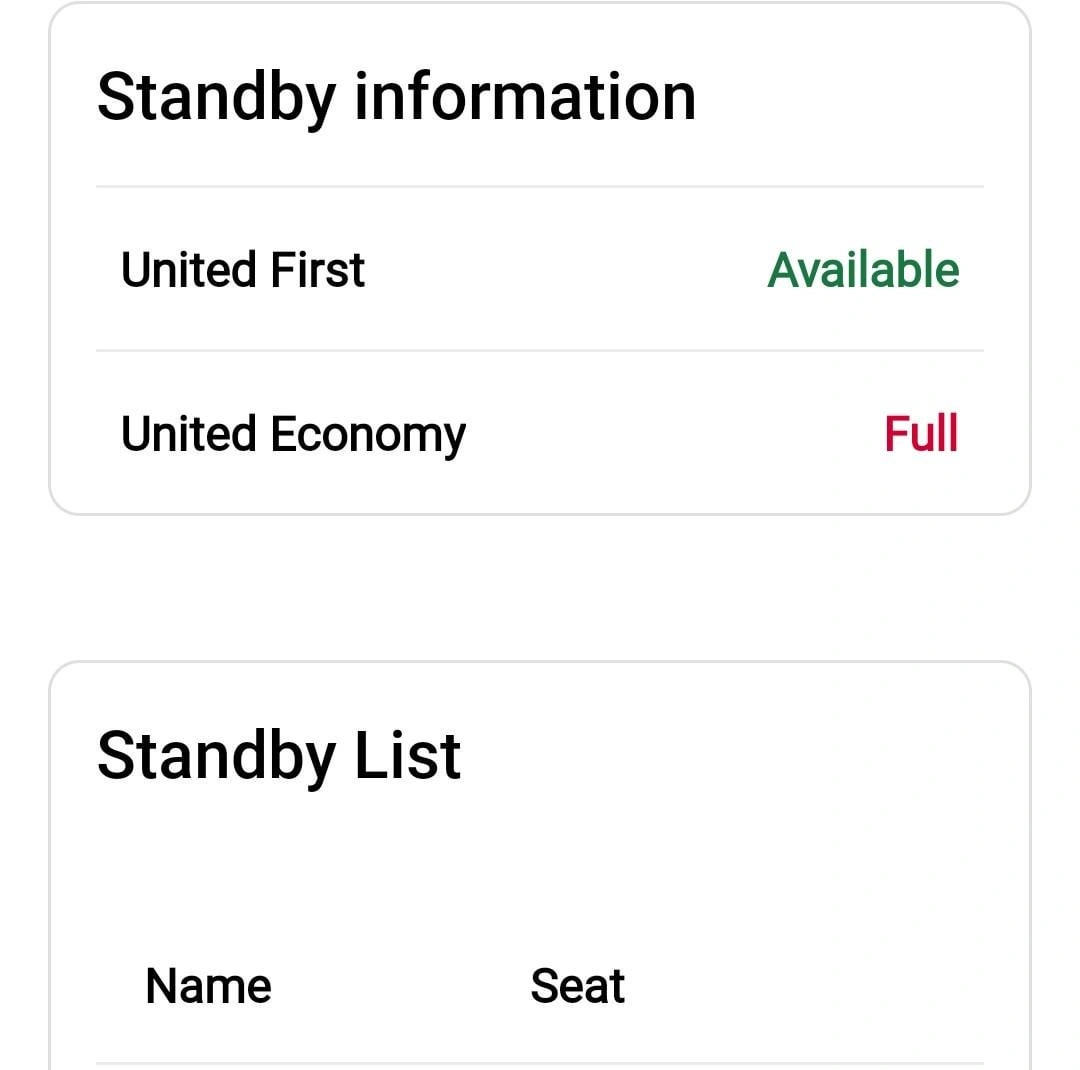
United Airlines allows MileagePlus members at the Premier Silver level and above to request standby for an earlier same-day flight at no charge. Non-elite members on most fare types pay a same-day change fee or are ineligible entirely. The standby list opens when the earlier flight is available in the system typically a few hours before departure.
United Tier | Same-Day Standby Fee | Priority Level |
No status (Basic Economy) | Not permitted | N/A |
No status (standard fare) | $75 fee | Low |
Premier Silver | Free | Medium |
Premier Gold / Platinum / 1K | Free | High |
Delta and American Airlines operate similar tiered systems. The consistent pattern across all three: loyalty status is the single most powerful variable in your standby outcome.
Your Rights When an Airline Bumps You Involuntarily

triggers specific passenger protections under U.S. Department of Transportation rules. These rights apply when you hold a confirmed reservation, checked in on time, and the airline cannot accommodate you on your original flight.
The DOT compensation scale for involuntary bumping as of 2024:
Delay to Final Destination | Compensation Cap |
Under 1 hour | No compensation required |
1–2 hours (domestic) | 200% of one-way fare, max $775 |
Over 2 hours (domestic) | 400% of one-way fare, max $1,550 |
1–4 hours (international) | 200% of one-way fare, max $775 |
Over 4 hours (international) | 400% of one-way fare, max $1,550 |
The airline must pay this compensation in cash or check if you request it. Vouchers are offered first and airlines train gate agents to lead with vouchers but you are not required to accept one.
For a broader look at how passenger protections intersect with airline safety standards and operations, the Air Gazette guide on airline dynamic pricing and revenue management explains how yield management systems drive the decisions that lead to overbooking.
Crucially, these protections apply only to involuntary denied boarding. If you voluntarily gave up your seat in exchange for compensation, you negotiated that deal and forfeit the DOT minimums. The full rules are published by the DOT Office of Aviation Consumer Protection and cover every scenario in detail. Understanding this distinction before you approach the gate agent matters.
What to Do When You Find Yourself on Standby

Knowing what happens if you are on standby for a flight is one thing. Knowing how to act quickly is another. The window between being placed on standby and the door closing is often under 30 minutes.
Follow these steps in order:
Ask immediately whether this is voluntary or involuntary the answer determines your compensation rights
Request written confirmation of your standby status and your position on the list
Ask what the next available confirmed seat is not the next standby opportunity, but a guaranteed seat
Check the airline app in real time
seat maps update as passengers check in and cancellations process; you may see a seat open before the gate agent calls your name
Do not leave the gate area airlines are not obligated to page you, and missing your boarding call removes you from the list
Request meal vouchers and accommodation if the delay pushes past meal times or overnight these are not automatic but are often available on request
What to Do If You Miss Your Connecting Flight Because of Standby
If involuntary standby causes you to miss a connection that was booked on the same itinerary, the airline is responsible for rebooking you at no charge on the next available flight. This includes flights on partner carriers if the airline's own next departure does not serve your destination in a reasonable timeframe.
Document everything. Screenshot your boarding pass, your standby notification, and any text messages from the airline. This documentation matters if you later file a complaint or request additional compensation. For context on how airlines handle disrupted operations across their networks, the Air Gazette analysis of United, American, and Delta pilot salary structures provides useful background on the labor agreements that shape crew scheduling one of the less-discussed drivers of last-minute aircraft swaps and overbooking consequences.
How to Protect Yourself Before You Ever Reach the Gate
The best standby strategy is to never end up on standby in the first place. Several steps taken at booking and check-in significantly reduce your exposure.
Practical steps to lower your overbooking risk:
Choose direct flights over connections each connection leg multiplies your exposure to overbooking and missed connections
Check in online exactly when the window opens usually 24 hours before departure since earlier check-in improves standby priority if you do end up on the list
Book the first flight of the day on routes you cannot afford to miss; airlines cannot delay an overnight aircraft from a previous flight
Avoid booking on the cheapest fare class on critical travel days; flexible fares cost more but rank higher on the standby list and often include same-day change options
Build loyalty status deliberately even mid-tier status on one carrier provides meaningful standby priority improvement on the routes you fly most
The scale of the problem is smaller than most passengers assume. U.S. carriers recorded just 0.28 involuntary denied boardings per 10,000 passengers across full-year, according to BTS data but that fraction still represents tens of thousands of real disruptions. The steps above keep you out of that pool.
The Air Gazette breakdown of ANA vs JAL includes carrier-specific reliability data that directly affects overbooking exposure on high-demand transpacific routes.
For travelers who frequently book international routes using transferred credit card points a strategy that typically places you in premium cabins on carriers like ANA or JAL the future of business class piece is worth reading for context on how award inventory and yield management interact on transpacific routes.
Conclusion
Airlines put confirmed passengers on standby because the system is designed to maximize revenue, not to guarantee your seat. Overbooking is legal, deliberate, and mathematically managed. However, the rules that govern what happens next are firmly on the passenger's side if you know them.
Know the difference between voluntary and involuntary standby before you speak to a gate agent. Understand that cash compensation is your legal right, not a voucher you have to accept. And build the check-in habits and loyalty status that keep you at the top of the list when the model gets the numbers wrong.
For more aviation guides covering airline operations, passenger rights, and route strategy, explore the full coverage at Air Gazette.
Frequently Asked Questions
What does standby mean on a flight?
Standby status means your boarding is not confirmed. You are placed in a queue to fill an empty seat if one becomes available before the flight departs. The airline works through the standby list in priority order, and there is no guarantee you will board that flight.
Can an airline put you on standby for a flight you already paid for?
Yes. Airlines legally oversell flights and can deny boarding to confirmed passengers if more ticketed passengers show up than there are seats. This is called involuntary denied boarding, and it triggers DOT compensation rules if it delays your arrival by more than one hour.
What happens if you are on standby for a flight and don't get on?
If you are on involuntary standby and do not board, the airline must rebook you on the next available flight at no charge. If the delay reaches certain thresholds, you are also entitled to cash compensation under DOT rules up to $1,550 for domestic flights delayed more than two hours.
How do you get on a standby flight faster?
Your standby priority depends on your loyalty tier, fare class, and check-in time. Elite frequent flyers and full-fare ticket holders rank highest. Checking in early and holding at least mid-tier status with the airline are the two most controllable factors.
Do airlines have to tell you why you're on standby?
Airlines are required to inform involuntary standby passengers of their rights, the reason for denied boarding, and the compensation they are entitled to. Voluntary standby is at the passenger's request, and no explanation is owed in that direction.
Is standby the same as being waitlisted?
No. A waitlist typically applies before a flight is purchased you are waiting for a seat to become available to book. Standby occurs after booking, at the airport, when you are already ticketed but seat availability is uncertain due to overbooking or a same-day change request.
Can you request to be on standby for an earlier flight?
Yes, on most airlines and fare types outside of Basic Economy. The process and fees vary by carrier and loyalty tier. United, Delta, and American all allow same-day standby for earlier flights, with fees waived for elite members. Request standby through the airline app or at the gate as early as possible to maximize your list position.